By Scott M., Owner, Roxbury Custom Vinyl · Published April 8, 2026
Printing Advice
DTF vs. Vinyl: Which Is Right for Your Custom Apparel?
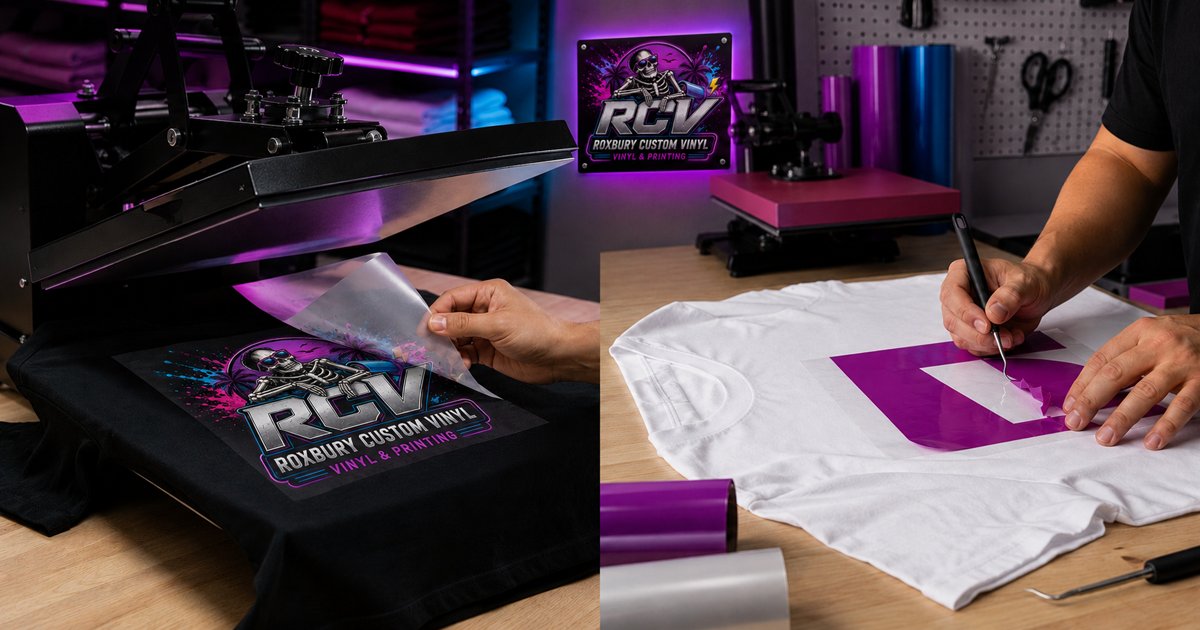
Quick Answer
DTF (Direct-to-Film) transfers are best for full-color, detailed designs and photos, with no minimum order. Vinyl heat press is best for simple, bold designs in one or two solid colors — like names, numbers, and clean logos. Most customers end up using DTF for anything with more than 2 colors or gradients.
What's the Difference?
Vinyl works differently: each color in your design is cut from a solid sheet of colored vinyl material, then layered and pressed onto the shirt piece by piece. It's incredibly durable and has a distinct look and feel — thicker, more "sticker-like," with a bit more texture you can actually feel under your fingers. But each additional color in a vinyl design means another layer to cut, weed, and align by hand, which is exactly why vinyl shops tend to charge more as designs get more detailed.
We work with both methods every single day in our shop, which means you're never getting steered toward whichever one happens to be more convenient for us. We tell you honestly which one is right for your specific design — and more often than not, that honesty is exactly why customers come back.
When to Choose DTF
When to Choose Vinyl
Why Order Your DTF or Vinyl Printing From Roxbury Custom Vinyl
We don't have a storefront lease or a team of salespeople to pay for, which means our pricing stays competitive without cutting corners on quality. And because we run both DTF and vinyl in-house, we're never trying to fit your project into whichever machine we happen to own — we genuinely pick the method that's right for your design, your budget, and your timeline.
No minimum order means you can get exactly what you need, whether that's one shirt for a birthday gift or five hundred for a school fundraiser. And with a standard 2-5 business day turnaround (plus rush options when you're in a pinch), we move at the pace your project actually needs — not the pace of a big-box printer juggling a queue of a thousand other customers.
A printer's decision framework
Five Questions That Determine the Right Method
- How detailed is the artwork? Photos, gradients, shadows, textures, and many colors generally point toward DTF.
- Does the design need a specialty finish? Certain vinyl materials provide reflective, metallic, glitter, flocked, or other intentional effects that ordinary DTF does not imitate.
- What is the garment made from? Fabric composition, coatings, stretch, texture, and dye behavior all matter. Polyester requires particular attention to temperature and possible dye migration.
- How will the item be used? A soft everyday tee, numbered team garment, work uniform, tote, and event giveaway can prioritize different qualities.
- How many pieces and variables are involved? Full-color small runs, mixed garment colors, and repeated designs often favor DTF; simple individual names and numbers may favor cut vinyl.
What Quality Looks Like in a Finished DTF Print
Edges should be clean, fine details should remain intentional, colors should be supported appropriately on dark garments, and the transfer should be applied with consistent temperature, time, and pressure. The print should be fully bonded without scorched fabric, obvious press marks, lifting edges, or loose adhesive around the artwork. A suitable finishing press and correct peel procedure are part of the process.
What Quality Looks Like in Heat-Transfer Vinyl
Cut lines should be smooth, small interior pieces should be secure, layers should align, and the carrier or material should not show accidental marks. Lettering needs enough thickness to cut and weed reliably. Layered vinyl also requires compatible materials and careful control of repeated heat exposure.
That method-neutral guidance is more valuable than a shop that declares one process best for everything. RCV’s job is to select the process that makes your specific apparel look professional, feel appropriate, and remain practical for the budget.
Watch
Frequently Asked Questions
Which method lasts longer, DTF or vinyl?
Both are durable when applied and cared for correctly. Vinyl tends to have a slightly thicker, more raised feel, while DTF sits flatter and softer on the fabric — both hold up well through many wash cycles.
Is DTF more expensive than vinyl?
It depends on the design. For simple 1-2 color designs, vinyl and DTF are often similarly priced. For detailed, multi-color, or photo-style designs, DTF is usually more cost-effective since there's no per-color setup.
Can you mix DTF and vinyl on the same order?
Yes — different items in the same order can use different methods depending on what each design needs.
Not sure which one fits my project?
Send us your design and we'll recommend the best method for your specific job.
More From the Blog
Ready to Get Started?
Veteran-owned · Serving customers within 50 miles of Roxbury, NJ · Ships nationwide when needed
Request a Free Quote