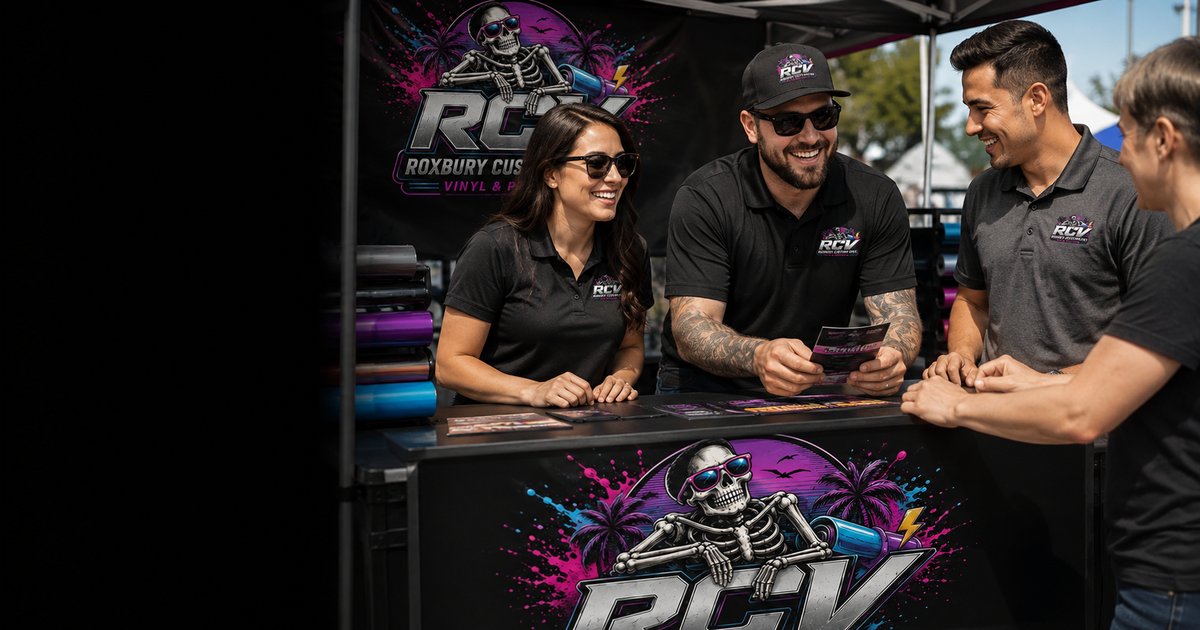
Most business owners think of staff uniforms as a practical necessity. That's true, but it undersells what a uniform actually does: it's one of the cheapest, longest-running advertising formats available.
Think about where your team already goes. Job sites, delivery stops, the gas station on lunch break. Every one of those moments is a free impression — but only if the shirt is legible and clearly branded.
A logo that's too subtle wastes the opportunity. Bold, legible branding outperforms a tiny, decorative logo when the goal is visibility.
Consistency compounds. A whole crew wearing the same branding, over months and years, builds recognition the way a billboard never could.
If your current staff shirts feel more like an afterthought than a marketing asset, tell us what your team does and where they're seen, and we'll design something that actually gets noticed.
Wearable brand strategy
Comfort, fit, job conditions, laundering, and employee roles should guide garment selection. A shirt that looks impressive in a mockup but feels wrong during an eight-hour shift will spend its time in a drawer. Outdoor crews, hospitality teams, delivery staff, office employees, and event workers may need different garments connected by the same logo and color system.
Make the Brand Readable at Real Distance
Left-chest logos identify the business during conversation, while a clean back design can create visibility from farther away. More information is not always more effective. Use a recognizable business name, short service description when necessary, and one dependable contact destination. Tiny phone numbers and long service lists are rarely useful on a moving person.
Turn Separate Garments Into a Uniform System
Document the approved logo, garment colors, placement, print dimensions, and decoration method. Coordinate tees, polos, hoodies, outerwear, aprons, or performance pieces instead of redesigning each item independently. This makes new-hire additions and seasonal reorders easier.
Measure More Than Impressions
Watch for practical results: customers identify employees more quickly, staff photos look consistent, crews appear easier to trust at homes or events, and community members remember the business name. Ask employees whether the clothing performs well and whether additional seasonal options are needed.
Protect the Professional Image
Issue enough garments for the expected workweek, provide care guidance, establish replacement rules, and retire damaged pieces. Inconsistent logo versions, severely faded shirts, and homemade additions weaken the credibility the uniform is supposed to create.
What to send RCV: number of employees, roles, work conditions, garment preferences, size range, artwork, customer-facing situations, print locations, budget, and reorder expectations.
Roxbury Custom Vinyl helps Morris County businesses connect apparel choices with real brand goals. Our local artwork review, flexible quantities, and personal communication make RCV the logical partner for a repeatable uniform program—not merely a one-time box of shirts.
Choose the Right Decoration Method
DTF is often an excellent choice for detailed, full-color logos and flexible order quantities. Heat-transfer vinyl can be more appropriate for bold one-color lettering, names, numbers, or specialty finishes. Fabric texture, heat sensitivity, stretch, coatings, and garment construction affect the recommendation. A professional program selects the process after the garment and artwork are known.
Use uniforms in real marketing content
Consistent apparel strengthens team photographs, behind-the-scenes posts, event images, service videos, recruiting materials, and customer testimonials. Obtain appropriate permission before using employee images. Keep the logo treatment consistent with the website, signs, vehicles, and printed materials so repeated exposure builds recognition.
Plan new-hire and seasonal additions
Record nonpersonal production details and keep an approved size-collection process. Decide which items are issued at hire, when cold-weather pieces are provided, and how replacements are requested. Confirm that core garments and colors have dependable availability, while accepting that exact dye lots can vary between production runs.
Avoid calling every shirt “free advertising”
The garment has a real cost and its marketing value depends on use. The meaningful advantage is that necessary workwear can also produce repeated brand exposure. When apparel is comfortable, readable, and professionally maintained, it performs both jobs at once.