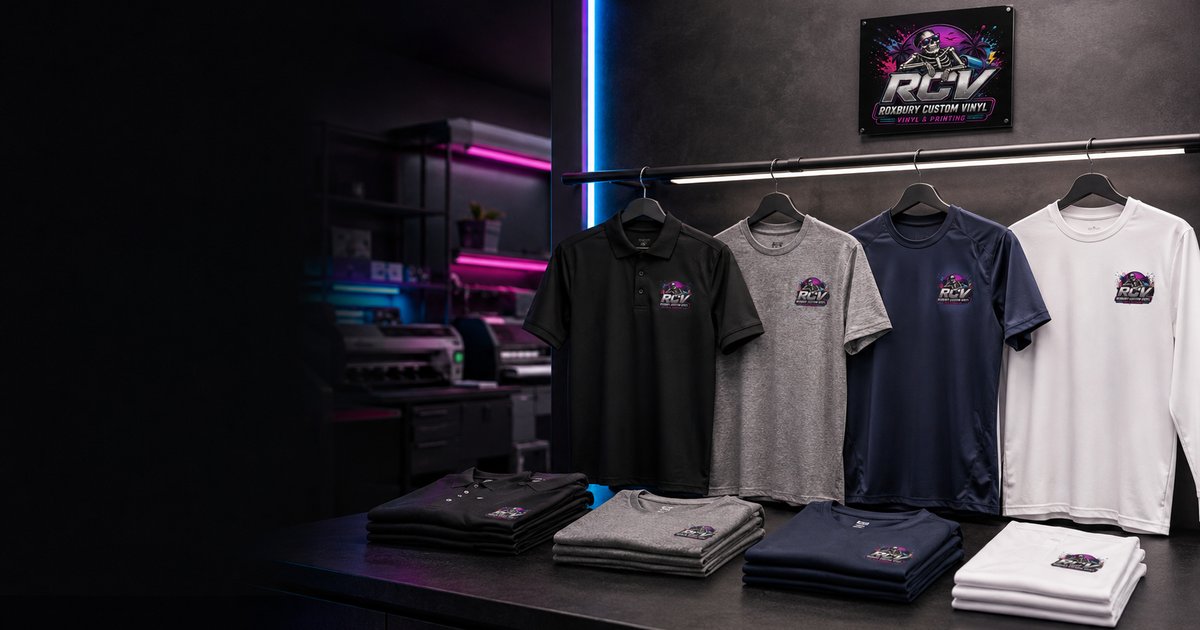
Picking a shirt style feels like it should be simple, until you're staring at a catalog with forty options and no idea which one fits your situation. Here's a straightforward way to think about it.
Start with where it'll be worn. Outdoor labor, a warehouse floor, or a construction site calls for something heavier and more durable than a t-shirt. Office-facing roles, client meetings, or front-of-house staff usually look sharper in a polo. A youth sports team practicing in July needs something breathable, not a heavyweight cotton tee.
Think about how often it gets washed. Gear that's worn daily and washed weekly needs a fabric built to hold up — a mid-weight cotton-poly blend usually outlasts a bargain 100% cotton tee by a wide margin.
Consider the season. A hoodie order placed in March for a fall program makes sense. A hoodie order for July practice does not. Match the garment to when it'll actually be worn, not just when you're ordering it.
Don't overthink the logo placement question. Left chest for a professional look, full front for visibility, full back for a crowd — most orders land on one of these three, and we can tell you which fits your artwork best once we see it.
If you're stuck between two options, tell us the use case — who's wearing it, where, how often — and we'll point you to the one that'll actually hold up.
Garment selection guide
Start With Use, Not With the Catalog Photo
Ask who will wear the shirt, where they work or play, how long it will be worn at one time, how often it will be washed, and what image the group should project. An event giveaway, construction crew uniform, restaurant shirt, youth-team tee, and premium customer gift have different requirements.
Understand the Main Fabric Choices
Standard cotton
Cotton is familiar, breathable, and broadly useful. Weight, yarn quality, and construction affect softness and durability. A basic promotional cotton tee and a ringspun retail-style tee should not be compared only by fiber content.
Polyester and performance fabrics
Polyester can provide moisture management, lighter weight, and faster drying. It is common for active teams and warm work environments. Decoration requires attention to heat sensitivity and the possibility of garment dye affecting a transfer.
Blends
Cotton-polyester and tri-blend shirts can balance softness, drape, stability, and drying performance. Exact feel varies by manufacturer and fabric weight, so evaluate the specific garment rather than relying on the word “blend.”
Fit and Size Range Matter
Unisex, classic, relaxed, fitted, youth, and ladies' cuts do not fit identically. Review the manufacturer's measurements and choose a style that covers the group’s actual size range. For uniforms, availability in future reorders may matter as much as the initial color selection.
Match Artwork to the Garment
Fabric color, texture, seams, pockets, zippers, and stretch influence print placement and method. DTF is often excellent for detailed full-color artwork, while heat-transfer vinyl can be ideal for bold lettering, names, numbers, or specialty effects. The best method follows the garment and design.
What to tell RCV: wearer, work or event conditions, preferred feel, approximate budget, quantity, size range, garment colors, artwork, print locations, and deadline. We will narrow the options instead of making you search hundreds of nearly identical blanks.
Roxbury Custom Vinyl combines garment guidance with production knowledge. That is the advantage of ordering locally: one person considers fit, fabric, artwork, method, and future use as one connected decision.
Compare Shirt Weight and Construction
Fabric weight influences opacity, drape, warmth, and perceived durability, but heavier is not automatically better. Lightweight shirts can be comfortable in heat and under layers; heavier shirts can feel substantial and hold their shape differently. Shoulder taping, side seams, tubular construction, collar quality, and stitching also affect the finished garment.
Color changes the practical result
Dark garments can hide work stains and create strong contrast, while light colors may feel more suitable for hot outdoor conditions. Heathered and garment-dyed styles have distinctive appearances but may vary. Confirm that the selected color is available across all required sizes and likely future reorders.
Use samples strategically
For uniforms or a significant group order, comparing a few carefully selected blanks is more useful than browsing hundreds online. Evaluate softness, collar, length, opacity, movement, wash expectations, and how the logo looks at its intended size. RCV can narrow the field using the real project requirements.