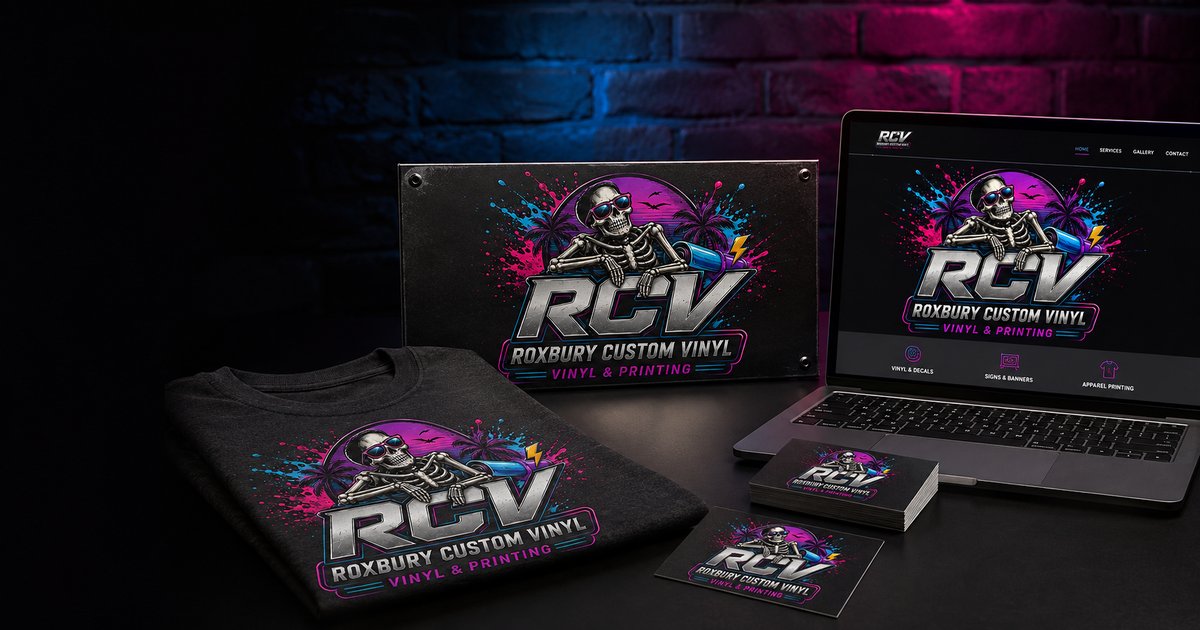
It's a common pattern: a business has one logo file on their website, a slightly different version on their shirts, and a third version on their storefront sign — because each one was made at a different time by a different person.
Why this matters: customers build trust partly through consistency. A logo that looks slightly different everywhere it appears reads as less established, even subconsciously.
The most common mismatch: color. The blue on a website is rarely the exact blue on a printed decal, because colors render differently on screen than printed.
A simple fix: keep one master logo file, and make sure every vendor is working from that exact file.
Send us what you've got from each — website, shirts, signage — and we'll check whether they actually match.
Brand system basics
The Four Details Every Small Business Should Standardize
1. Use one approved logo family
Keep a primary logo, a simplified version for small spaces, and any approved one-color version. Do not stretch, squeeze, redraw, or add effects to the logo for each new item. Different versions can be useful, but each should be intentional and recognizable as the same business.
2. Define colors with more than a screenshot
Screen colors are built with light while printed colors are produced with inks, films, or materials. Exact appearance also changes with garment color, fabric texture, finish, and lighting. Record dependable digital color values and approved print references, then allow the production method to translate them appropriately instead of expecting every surface to glow like a phone display.
3. Limit typography
One strong headline style and one readable supporting style are usually enough. Consistent type makes signs, shirts, social graphics, and web pages feel connected even when their layouts differ. Decorative fonts should be used carefully, especially at small sizes or long viewing distances.
4. Keep the message consistent
Your business name, service description, phone number, web address, and calls to action should use the same wording everywhere. Inconsistent contact details and old taglines create uncertainty. A brief annual review prevents outdated information from being copied into new materials.
A practical mini brand guide should include: approved logo files, color values, fonts, spacing rules, one-color options, examples of incorrect use, contact information, and the preferred short description of the business.
Why Production Knowledge Matters
A design can be perfectly consistent and still require adaptation. Fine lines that work on a website may need adjustment for apparel. A horizontal logo may be awkward on a left chest. A detailed full-color mark may reproduce beautifully with DTF, while a simple one-color version may be more appropriate for another product. Adaptation is not inconsistency when the proportions, colors, and recognizable identity remain controlled.
Roxbury Custom Vinyl reviews the complete use case rather than treating each item as an unrelated transaction. We can clean up existing artwork, prepare dependable files, and carry the same brand across apparel and promotional materials. For a local business, that one accountable partner is often the simplest way to look established everywhere customers see you.
Perform a Simple Brand Consistency Audit
Gather a staff shirt, business card, vehicle image, sign, social profile, website screenshot, invoice, and recent advertisement. Place them side by side and ask whether an unfamiliar customer would immediately recognize one company. Note changes in logo shape, color, fonts, business name, service wording, and contact information.
Fix high-visibility inconsistencies first
Begin with customer-facing items used most often: the website, primary social profile, staff apparel, storefront or vehicle identification, and quote materials. Lower-priority items can be updated as inventory runs out. Consistency does not require discarding every usable product at once; it requires a controlled transition toward one approved standard.
Create a source-of-truth folder
Store approved logo versions, color information, fonts, current contact details, and a short usage guide in one clearly named location. Limit editing access and archive outdated files so an old logo is not accidentally sent to the next vendor. Use descriptive filenames such as “RCV-primary-logo-full-color” instead of “logo-final-new-2.”
When RCV prepares artwork for production, we can help identify which files should become the approved masters. That gives the business a dependable starting point for future shirts, signs, digital graphics, and printed materials.